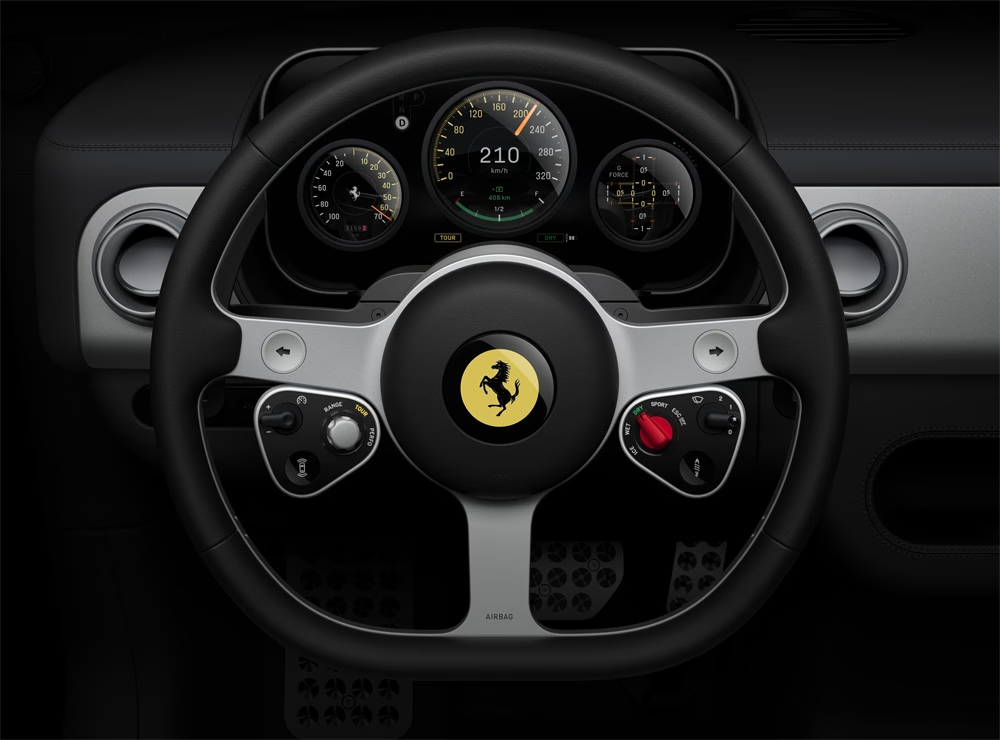
Samsung Display has announced it is exclusively supplying four OLED panels for the Ferrari Luce, Ferrari’s first fully electric production car.
Samsung Display’s four panels, in 12.9-inch, 12-inch, 10.1-inch, and 6.3-inch sizes, cover three interior zones: the driver’s binnacle, the central control panel, and the rear passenger panel.
The binnacle uses the industry’s first multi-layered OLED structure, stacking a 12.9-inch upper panel over a 12-inch lower panel. Three circular cutouts in the upper layer expose the display beneath, which renders background gauges and indexes. The upper panel handles real-time torque-shift indicators, pop-ups, and tell-tales. Physical mechanical hands move in the cavity between the two panels, replicating analogue instrument behaviour.
Producing the binnacle required Samsung Display’s HIAA (Hole in Active Area) technology at automotive scale. The hole measures approximately 100mm, around 20 times larger than a typical smartphone camera cutout. Thin Film Encapsulation seals the OLED materials at the cut edges, and signal routing was redesigned around the aperture to prevent image distortion or latency.
HIAA also features in the 10.1-inch central control panel, where three mechanical hands mounted through small perforations rotate 360 degrees in real time. A 6.3-inch OLED serves rear passengers for climate and driving information.
The Luce is Ferrari’s first fully electric sports car, powered by a four-motor drivetrain producing up to 1,050 horsepower. Its 122 kWh battery offers an estimated range of 530 kilometres, and it starts at €550,000 (approximately $640,000). The interior was designed by Jony Ive, the designer behind the iPhone and iMac, through his firm LoveFrom.

Leave a Reply